
How Bitcoin-Backed Loans Work
Understanding the mechanics of borrowing against your Bitcoin
We're sharing information about how these financial tools work. This is educational content to help you understand the concepts — what you do with this knowledge is entirely your choice.

Educational Information Only
This page explains how Bitcoin-collateralized loans work in general. This is not financial advice, and we are not recommending any specific action. Every person's financial situation is different. If you're considering using these tools, do your own research and consult with qualified professionals if needed.
The Basic Process
Here's how Bitcoin-backed loans typically work across most platforms
Deposit Your Bitcoin
You transfer Bitcoin to a lending platform where it's held as collateral. Think of it like putting up security for a traditional loan, except your Bitcoin stays in your name — it's just temporarily locked.
Most platforms require you to maintain a certain collateral ratio (often 130-200% of the loan value) to account for Bitcoin's price volatility.
Receive Cash or Stablecoins
Once your Bitcoin is deposited, the platform releases funds to you — typically 50-70% of your collateral's value. This percentage is called the Loan-to-Value (LTV) ratio.
Lower LTV means more safety margin but less borrowing power. Higher LTV gives you more funds but increases liquidation risk if Bitcoin's price drops.
Use the Funds Freely
The money is yours to use however you want — paying bills, investing, buying a house, starting a business. Meanwhile, your Bitcoin remains locked but still belongs to you.
If Bitcoin appreciates while your loan is active, your collateral becomes worth more, potentially allowing you to borrow additional funds or have a larger safety buffer.
Repay and Reclaim
When you're ready, repay the loan amount (plus any fees or interest, depending on the platform). Once settled, your Bitcoin is unlocked and returned to you in full.
Some platforms allow partial repayments, while others require full settlement. Check the terms before committing.
Understanding Leverage
How borrowing can amplify both gains and losses
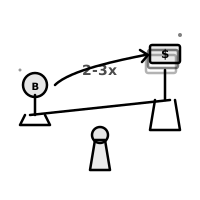
Leverage means using borrowed money to potentially increase returns. With Bitcoin-backed loans, you're essentially leveraging your Bitcoin holdings.
A Simple Example
You have 1 BTC worth $100,000.00. Instead of selling it, you use it as collateral to borrow $50,000.00 (50% LTV).
If Bitcoin doubles to $200,000.00: Your 1 BTC is now worth $200,000.00. You repay the $50,000.00 loan and still have your 1 BTC — effectively gaining the full price appreciation while having used $50,000.00 in the meantime.
If Bitcoin drops 50% to $50,000.00: Your collateral is now worth only $50,000.00, barely covering your loan. You might face liquidation, losing your Bitcoin to repay the debt.
Leverage amplifies outcomes in both directions. The same mechanism that can multiply gains can also multiply losses. This is why managing your LTV ratio and understanding liquidation risk is critical.
Some Loans Have No Monthly Payments
How certain platforms structure their crypto loans differently
Unlike traditional loans with monthly installments, some crypto lending platforms (like Binance, Nexo, and others) offer loans with no required monthly payments.
How This Works
- You deposit collateral and receive your loan
- There are no scheduled monthly payments to make
- Interest may accrue (or be zero, depending on the platform and terms)
- You repay whenever you want — in full or in parts
- Your only obligation is maintaining adequate collateral
Why This Matters
Traditional loans force you into a repayment schedule. Miss a payment, and you damage your credit or face penalties. With many crypto-backed loans, there's no payment schedule — you're in control of when and how much you repay. The main thing you need to watch is your collateral ratio.
Some Platforms Offer 0% Interest
Certain platforms (like Binance Loans with specific collateral types) offer 0% interest rates for limited periods or under certain conditions. This means you could borrow money and only repay exactly what you borrowed — no interest charges at all.
Always read the fine print. 'No monthly payments' doesn't mean 'no obligations.' You must maintain your collateral ratio, and if Bitcoin's price drops significantly, you may need to add more collateral or face liquidation.

Key Things to Understand
Loan-to-Value (LTV)
The ratio between your loan amount and collateral value. A 50% LTV means you borrowed half of what your collateral is worth. Lower is safer.
Liquidation
If your collateral value falls too much (your LTV gets too high), the platform will sell your Bitcoin to cover the loan. This is the main risk.
Collateral Ratio
The inverse of LTV — how much collateral you have relative to your loan. A 200% collateral ratio means you have twice the collateral needed.
Margin Call
A warning from the platform that your collateral is getting low. You'll need to add more Bitcoin or repay part of the loan to avoid liquidation.
Remember the Risks
Bitcoin-backed loans can be powerful tools, but they come with real risks. Liquidation can happen fast during market crashes. Platform failures (like we've seen with some crypto companies) can put your collateral at risk. Never borrow more than you can afford to lose, and always have a plan for what happens if Bitcoin's price drops significantly.
Top Lending Platforms
Choose a provider and start borrowing today.




Some links are referrals that help support the site.